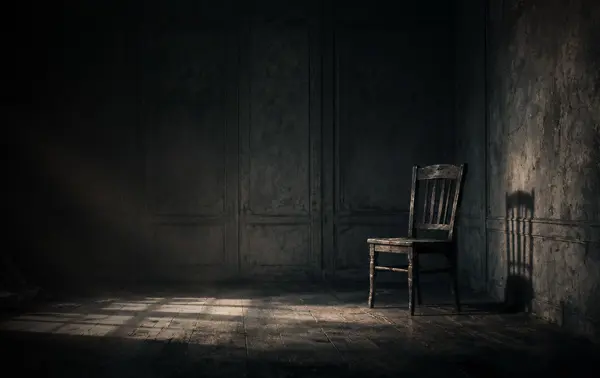
 November 22, 2026
Devlog #08
Why the Game Begins with an Empty Room?
READ MORE
The Voice of Franz
But because I wanted every player to lend him their own. It was another limitation I deliberately set for myself while developing The Morning After You.
I didn't want a voice actor to define Franz's age, emotions, or personality before the player had a chance to discover them.
Sometimes, too instantly.
So throughout the game, Franz's thoughts were meant to remain silent. I never wanted those thoughts to become long inner monologues.
Instead, I challenged myself to express them in as few words as possible. To remove everything that wasn't essential. To leave behind only a feeling.
A memory. A question.
My nephew, Daniel Křižka, recently recorded Franz's voice. And he surprised me.
He understood the character's sadness, vulnerability, and emotions in a way I hadn't expected.
Suddenly, Franz had a voice. And it felt right.
I decided to use it only for longer passages. Letters, diary entries, and fragments of his past.
The short thoughts and observations remain silent.
Players can read much faster than Franz speaks. And I don't want to force anyone to wait.
In Fragments, where you collect photographs, letters, and diary pages, you can read everything at your own pace.
But I'd like to suggest something. When you hear Franz's voice, stop reading ahead. Just listen.
Because sometimes, the way a person says something reveals more than the words themselves.
A hesitation. A breath. A sadness hidden between sentences.
You might discover something you would miss by reading alone. I don't want to force anyone to experience the game in a particular way.
It's a story I hope you'll take the time to experience. The words shouldn't interrupt the atmosphere. They should become part of it.
Just like the sound. The music. The visuals. And the silence.
Many of Franz's thoughts are written as metaphors. They don't explain the story.
I don't want every storytelling element to repeat the same information. I want them to complement one another.
The image can ask a question.
The sound can challenge it. The music can give it emotion. And Franz's thoughts can quietly shift its meaning.
Each layer tells a different part of the story.
Only together do they create the whole picture.
But I still don't want his thoughts to explain the story. I want them to reveal the person who lived it.
November 22, 2026
Why the Game Begins with an Empty Room?
READ MORE November 10, 2026
Who Creates the Style?
READ MORE October 18, 2026
The World You Hear
READ MORE October 12, 2026
Simplicity Is Strength
READ MORE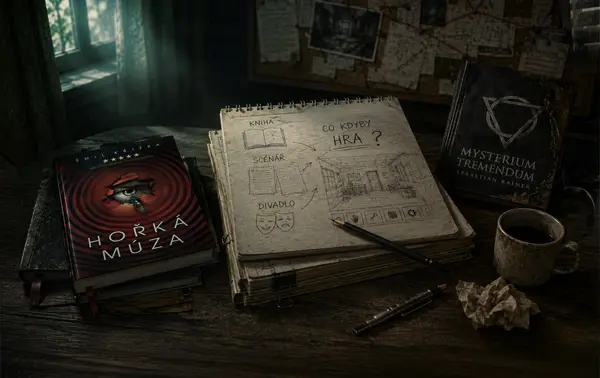 October 4, 2026
During the COVID pandemic, I wrote a novel called Bitter Muse.
READ MORE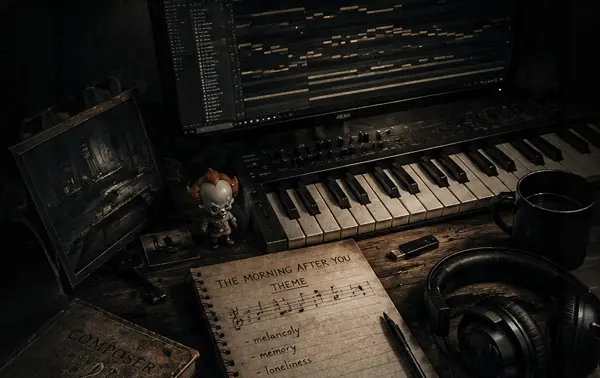 July 6, 2026
I've loved music for as long as I can remember.
READ MORE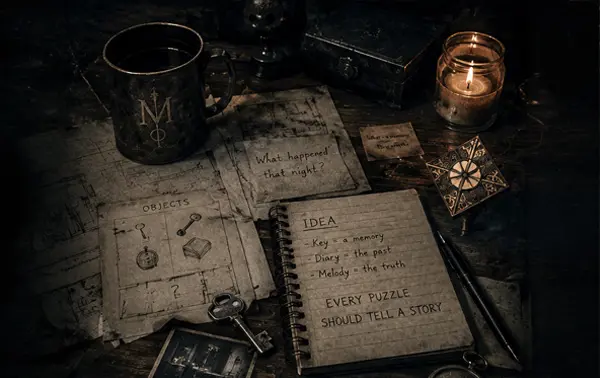 June 28, 2026
One thing has always bothered me about many point-and-click adventures.
READ MORE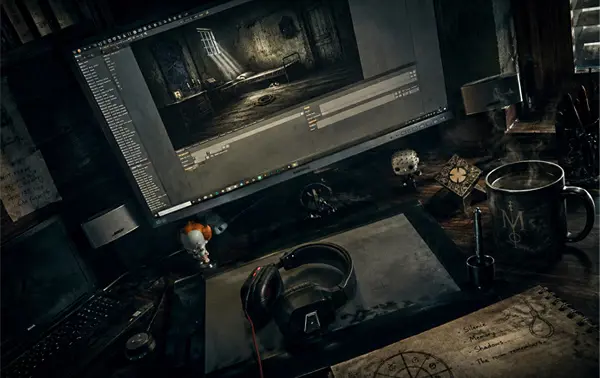 June 5, 2026
I've always loved games that could completely draw me in.
READ MORE